
Calculus started making a lot more sense for me once I started looking at it in terms of infinitesimals. An infinitesimal is a strange mathematical object, but once we get a good understanding of what they are, then integrals, differentials, and the Fundamental Theorem of Calculus all drop into place.
I think it is easiest if we start with integrals. Integrals were known to Archimedes, arguably the greatest mathematician humanity ever produced. Had Archimedes also discovered derivatives, plus the fact that the integral of a function equals its anti-derivative, then modern science might have developed some 2,000 years earlier than it did. But all of these ideas employ infinitesimals, an idea that most classical mathematicians, Archimedes included, found abhorrent. He definitely knew about them, though. In the twentieth century, we found a lost work of his called The Method, and it details numerous theorems that depend on both the integral and on his theory of the lever. The document is in fragments, but here is one unbroken chunk of it:
Theorem 8Produce AC to H, 0, making HA equal to AC and CO equal to the radius of the sphere; and let HC be regarded as the bar of a balance, the middle point being A.In the plane cutting off the segment describe a circle with G as centre and radius (GE) equal to AG; and on this circle as base, and with A as vertex, let a cone be described. AE, AF are generators of this cone.Draw KL, through any point Q on AG, parallel to EF and cutting the segment in K, L, and AE, AF in R, P respectively. Join AK.
NowHA:AQ = CA:AQ=AK2:AQ2=(KQ2+QA2):QA2=(KQ2+PQ2):PQ2=(circle, diam. KL + circle, diam.PR):(circle, diam. PR).Imagine a circle equal to the circle with diameter PR placed with its centre of gravity at H; therefore the circles on diameters KL, PR, in the places where they are, are in equilibrium about A with the circle with diameter PR placed with its centre of gravity at H.Similarly for the corresponding circular sections made by any other plane perpendicular to AG.Therefore, taking all the circular sections which make up the segment ABD of the sphere and thecone AEF respectively, we find that the segment ABD of the sphere and the cone AEF, in the places where they are, are in equilibrium with the cone AEF assumed to be placed with its centre of gravity at H.Let the cylinder M+N be equal to the cone AEF which has A for vertex and the circle on EF as diameter for base. Divide AG at V so that AG = 4VG; therefore V is the centre of gravity of the cone AEF; for this has been proved before.
Let the cylinder M+N be cut by a plane perpendicular to the axis in such a way that the cylinder M (alone), placed with its centre of gravity at H, is in equilibrium with the cone AEF.Since M+N suspended at H is in equilibrium with the segment ABD of the sphere and the cone AEF in the places where they are,while M, also at H, is in equilibrium with the cone AEF in the place where it is, it follows thatN at H is in equilibrium with the segment ABD of the sphere in the place where it is.

An aside for those who want to follow Archimedes’ proof closely:1:If you are puzzled byCA:AQ=AK2:AQ2,it had me confused, too. It works because as a general property of all circles, AQ:QK=QK:CQ for any upright QK anywhere along a diameter AC. From this, it follows that AQ*CQ=QK2.But by the Pythagorean Theorem, QK2+AQ2=AK2. Substituting for QK2 gives us CQ*AQ+AQ2=AK2, which we rearrange as (AQ+CQ)*AQ=AK2.Because CA=AQ+CQ, it follows that CA*AQ=AK2. Dividing both sides by AQ2 yields CA:AQ=AK2:AQ2, Q.E.D.2:Archimedes also expects the reader to be familiar with his law for balancing a mass on a lever arm; for a balance bar of length A, at the end of which is a mass B, these can be balanced by some other length and mass of quantities C and D, respectively, only if A*B=C*D. This is a very useful law that finds broad application in physics and engineering.3:Finally, Archimedes had previously established that AQ was equal to PQ.
There are infinitely many circles of diameter PR (a bit of a misnomer there; there are infinitely many diameters, ranging in length from 0 to EF, all of which we are calling PR), all infinitely thin. Likewise circles of diameter KL. Any sum of infinitely thin things would be zero, except that in this case we have infinitely many of them. Infinitely many of the infinitely small adds up to something. In this case, Archimedes has managed to construct from infinitesimals both a cone and a sphere.
And that is an integral. That’s all it is; infinitely tiny pieces added together infinitely many times. Their grand sum works out to be a finite quantity. Of course, those infinitely tiny pieces are called infinitesimals.
Now, as mathematical objects, infinitesimals possess a certain slippery property that I  want to explore. Notice the intersection that I have circled. This is an intersection of the cone AEF and the sphere. At that point, RP=KL. Surely, at this location, the infinitesimals of the cone and the sphere are equal, right?
Not quite equal, I think; all the infinitesimals PR are adding up to equal a cone, while the KL infinitesimals are adding up to create a sphere. I don’t think a cone’s infinitesimal and a sphere’s infinitesimal are quite the same thing. For an infinitesimal not only possesses a certain extent (that is to say, a certain length; we can speak meaningfully of PR’s length in one direction even if it is infinitely thin in another direction), but it also abuts its neighboring infinitesimals in some characteristic way. Each infinitesimal PR joins to its neighboring infinitesimals PR in a manner characteristic of a cone. The many infinitesimals KL all connect together in a manner characteristic of a sphere. I say the manner in which an infinitesimal connects to its neighbors is something inherent to the infinitesimal itself; I say that at the location where the length PR equals KL, the isolated infinitesimal PR, all by itself, is inherently a cone infinitesimal, while the corresponding KL infinitesimal is inherently a sphere infinitesimal. They might be the same length at that location, but they have this other inherent quality that is different. So too all the other infinitesimals PR and KL; the way in which these infinitesimals stack up with their neighbors is inherently a part of each individual infinitesimal.
What happens if we try to stack dissimilar infinitesimals onto each other? If a PR is followed by a KL, for example? We get a discontinuity. Because their lengths are the same, they will stack, but it would be like truncating a cone and a sphere, at a point where they both have the same radius, and then gluing them together. There is a sharp discontinuity where the cone infinitesimals meet the sphere infinitesimals.
Can we find mathematically rigorous descriptions of these ways in which infinitesimals fit together? We can, and readers who know calculus may have already guessed what it is: the derivative. At that intersection where the lengths PR and KL equal, the derivatives of the cone and sphere differ markedly. In standard calculus courses, students are taught that the derivative is the “rate of change at a point,” also that it is tangent to the function at that point. Anyone can see that where KL=PR, the tangents are nothing alike.
Airplane pilots are taught how to navigate by “dead reckoning;” from their instruments, they can see their airspeed and direction. If they know their starting point and they keep close watch of time, then it is possible to navigate solely by instruments; north at 400 kts for one hour followed by west at 300 kts for one hour puts us 500 nautical miles NNW of our starting point. In the case of aviation, this technique is delightfully precise. Taking an integral does the same thing; it reckons the change introduced by one infinitesimal, followed by the change in the next infinitesimal and so on, ad infinitum.
This dead reckoning process is stated more elegantly as the Fundamental Theorem of Calculus:
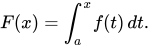
where dF(x)/dt = f(x). In words, the integral of a function equals its anti-derivative. (To be pedantic, we might also need to add a constant, but this is a trivial matter, corresponding to a pilot taking into account his starting position when he begins dead reckoning.) When we look at calculus in terms of infinitesimals, all the pieces fall into place.
With these ideas in mind, let’s look at a famous paradox involving infinitesimals. We have a rectangle ABCD. By drawing a diagonal BD, we get two triangles, ABD and BCD.

We should be able to measure the areas of the two triangles by means of the infinitesimals EF (for triangle ABD) and FG (for triangle BCD). Because they are each half of the same rectangle, the triangles must have equal areas. And yet, for every infinitesimal EF, the corresponding infinitesimal FG is shorter! The lengths of the infinitesimals implies that BCD must have a smaller area than ABD, a paradox.
I say, the paradox is resolved when we observe that the way in which the FG infinitesimals add together is different from the way the EF infinitesimals add together, and this is reflected in the relative slopes of the two triangles. Mutatis mutandis, the ABD triangle has a slope of magnitude AB/AD, and this fact is encoded in its EF infinitesimals. The BCD triangle has a slope equivalent to AD/AB (the reciprocal of ABD’s slope!), and its infinitesimals adjoin accordingly. When infinitesimals are properly understood, the two triangles work out to have identical areas.
 Of a Sphinx Athwart the Evening Sky